

Ice Dams on a Spokane Roof: What to Do Today and What Makes It Worse
The short answer
Do not chip the ice off with a hammer, an axe, or a shovel. You will go through the shingles and straight into a leak that costs far more than the ice dam did.
Instead, do three things in order:
- Pull the snow off the roof above the ice dam, not the ice itself.
- Cool the attic down so the roof stops melting snow from underneath.
- Put calcium chloride, not rock salt, on the ice in a sock or a pair of old pantyhose.
If water is already dripping inside your house, skip to the section below on leaks, or call us at (509) 404-4444. Water coming through a ceiling is a same-day problem.
What an ice dam actually is
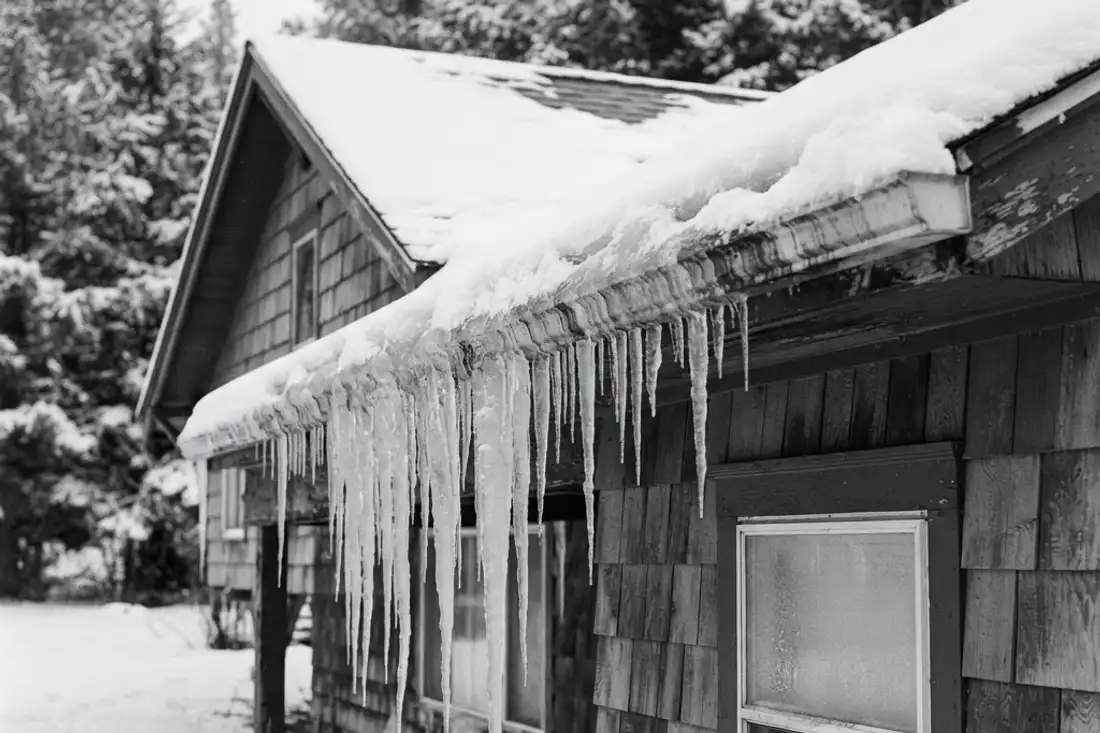
An ice dam is a ridge of ice that forms along the bottom edge of your roof, usually near the gutters. It happens because the upper part of the roof is warmer than the lower part.
The warm part melts snow. The water runs down the slope. When it reaches the cold eaves, it refreezes. Repeat that a few hundred times and you have a wall of ice with water backed up behind it.
The ice is not the damage. The water behind the ice is. It works its way under the shingle edges, into the underlayment, and eventually into your ceiling and walls.
Why Spokane roofs get them so easily
Our winters are built for it. We get snow, then a thaw, then rain, then a hard freeze, often in the same week. Every one of those swings pushes water toward the eaves and turns it solid again.
A few things make a house here more likely to ice up:
- Heat escaping into the attic. This is the big one. Warm air from the house rises, heats the roof deck, and melts snow that should have stayed frozen.
- Low-slope sections over porches and additions. Shallow roofs shed snow slowly, so there is more of it sitting there melting.
- Valleys and dormers. Snow collects in the same few spots every year, and so does the ice.
- No ice and water shield at the eaves. Older homes often have felt paper where a modern roof has a rubber membrane. The membrane is what saves you when water does back up.
- Gutters full of fir needles. Frozen, blocked gutters give water nowhere to go but sideways, into the fascia and the wall.
What is safe to do today
1. Get the snow off, leave the ice alone
Use a roof rake with an extension handle and stand on the ground. Pull snow down from the bottom edge upward, in small passes, and stay clear of the drop zone. Never walk on a snow-covered roof. You cannot see the edge and you cannot see a skylight.
Take the snow off the bottom three or four feet of roof first. That is the part feeding the ice dam.
2. Cool the attic down
This works better than most people expect and costs nothing. Seal the attic hatch. Turn off or lower any heat in the attic. If you have a whole-house fan or a leaky duct up there, shut it off. Open the soffit vents and make sure the insulation is not packed over them.
The goal is a roof deck that stays below freezing while it is snowing. Then nothing melts and nothing refreezes.
3. Use calcium chloride, not rock salt
Fill a sock, a nylon, or a piece of stocking with calcium chloride pellets and lay it across the ice dam, spaced every couple of feet. It melts a channel so the water behind the ice can drain.
Never use rock salt. Sodium chloride is brutal on shingles, on metal flashing, on gutter hangers, and on the plants below.
4. If water is coming inside
Move what you can out of the way. Put a bucket under the drip and put a towel down. Poke a small hole in a bulging ceiling with a screwdriver so the water has somewhere controlled to go instead of spreading through the drywall. Take photos before you clean anything up, because your insurance adjuster will want them.
Then call us. A temporary tarp and a proper repair is a much smaller bill than a soaked ceiling and wet insulation.
What makes it worse
- Chipping or hammering the ice. Shingles crack, granules come off, and flashing bends. The leak starts and it does not stop.
- Rock salt in a bucket. Same problem, faster.
- Heating the attic to melt it. You melt the snow on top, the water refreezes at the cold eaves, and the dam gets bigger.
- A pressure washer. This is the worst one. Never let anyone pressure wash a roof, in any season.
- Ignoring an interior stain. A stain means water has already been there for a while. It also means the insulation is wet, and wet insulation stops insulating.
Fixing it so it does not come back
Ice dams are a ventilation and insulation problem that shows up on your roof. The permanent fix is inside the house.
- Air sealing. Seal the gaps around can lights, bath fans, plumbing stacks and the attic hatch. That is where the heat is going.
- Insulation to the right depth. Blown-in insulation is cheap and it is the single best thing you can do for ice dams and for your heating bill.
- Balanced ventilation. Intake at the soffits, exhaust at the ridge. One without the other does very little.
- Ice and water shield at the eaves. When the roof is next replaced, make sure it goes in. It is the backup that catches what the attic fix misses.
Heat cable is the option people ask about most. It helps, and it is not a fix. It only clears the strip of roof where the cable sits, and it still has to drain somewhere. Treat it as a stopgap, not a solution.
When to call a roofer
Call us if any of these are true:
- Water is coming through a ceiling, a light fixture, or a wall.
- The ice dam is more than a few inches thick.
- The ice has pushed the gutters away from the fascia.
- You can see lifted shingles, cracked flashing, or missing granules below the ice line.
- This has happened two winters in a row.
An inspection is free, and it tells you whether you are looking at a maintenance item or a repair. From there, roof repair handles the damage and roof maintenance handles the gutters, ventilation and the annual check that keeps it from happening again.
Questions we get every winter
Can I just leave it until spring?
If there is no water inside and the ice is thin, yes, and it will probably melt out. If water is backing up under the shingles, no. Every day it sits there is another day of wet decking, and wet decking rots.
Does my insurance cover ice dams?
Sometimes. Most policies cover sudden water damage from the ice backing up, and usually not the removal of the ice itself or maintenance you skipped. Our insurance claim page walks through what typically counts. Call your agent before you assume anything either way.
Will a metal roof solve it?
Metal sheds snow much faster, which helps a lot. It does not fix a warm attic. If the attic is passing heat into the roof, you will still get ice on a metal roof, just less of it.
If ice is on your roof right now, send us a message or call (509) 404-4444. We are in Spokane Valley and we see this every single winter.
Want a roofer to look at it in person?
ALPHA LLC inspects roofs across Spokane Valley, Spokane and North Idaho. The inspection and the written estimate are free.